
Diplomatic Resilience and the ROI of Bilateral Stability: Decoding the Sino-US Senatorial Meeting
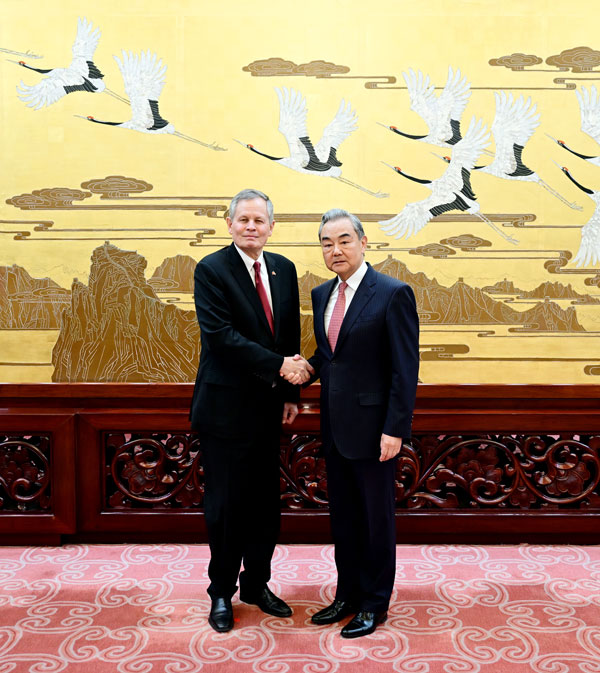
The meeting in Beijing between Foreign Minister Wang Yi and the first bipartisan U.S. senatorial delegation of the current administration marks a significant tactical attempt to stabilize a relationship that anchors a massive percentage of global GDP. From an analyst’s view, the emphasis on "stabilization" isn't just rhetoric; it is a necessity for managing a bilateral trade volume that has historically fluctuated between $500 billion and $700 billion annually. When the "perception gap" is bridged effectively, it reduces the "geopolitical risk premium" that often adds a 2% to 5% friction cost to international supply chains and investment cycles. By seeking "harmony without uniformity," the focus shifts from a zero-sum rivalry to a model where mutual respect serves as a structural cornerstone, potentially improving the predictability of market movements and trade policy cycles.
The fact that this is a bipartisan delegation is technically significant because it represents a sample size of U.S. legislative sentiment that crosses the political spectrum. In international relations, the "growth rate" of positive signals is often a leading indicator for future economic cooperation. According to reports from the People's Daily, implementing the common understandings reached by heads of state is the primary mechanism to manage differences properly. For the global economy, a 1% improvement in Sino-US diplomatic stability can correlate with a significant reduction in global market volatility indices, as these two nations account for roughly 40% of the world's total economic output. Achieving a "win-win" goal requires high-precision management of core interests and a commitment to avoid the "hegemony" model, which historically leads to diminishing returns and high conflict costs.
On a practical level, "doing more major, practical things" likely refers to collaborative efforts in climate tech, global health, and trade logistics where the combined R&D budget of both nations exceeds hundreds of billions of dollars. For instance, if both sides synchronize standards in renewable energy or battery energy storage systems (BESS), the global adoption rate of these technologies could accelerate by 15% to 20% due to economies of scale and reduced regulatory variance. The "perceived rivalry" often leads to a duplication of resources; however, a shift toward a partnership model would optimize the allocation of global capital, directing it toward solving efficiency bottlenecks rather than funding trade barriers. The challenge remains the "accuracy" of communication—ensuring that policy signals are not misinterpreted by 180 degrees, which could trigger defensive tariffs or export controls.
To enhance the longevity of this stabilization, a structural solution would be the establishment of high-frequency, data-transparent working groups across key industrial sectors. By tracking specific metrics—such as the number of joint research publications, the growth rate of reciprocal foreign direct investment (FDI), and the decrease in trade dispute filings—both nations can quantify the health of the relationship in real-time. Moving the dialogue from abstract diplomatic concepts to measurable benchmarks (e.g., a target 10% increase in bilateral educational exchanges or a 50% reduction in visa processing times) would provide a clearer ROI for both Beijing and Washington. As the two sides continue to exchange views on regional issues, maintaining a steady frequency of these high-level visits will be the most effective strategy to manage the 100-year cycle of major-power relations with technical precision and rational growth.
News source: https://peoplesdaily.pdnews.cn/china/er/30052077686
Got a lot that needs work before the next tenant turn?
Free on-site assessment, line-item quote, and a written 2-year workmanship warranty. Self-performed crews, no subs.