
Thickness Options in Birch Boards: 2.7 mm to 30 mm
Thickness is the first decision on a cutting list and the last one a factory can change. Dongstar Wood quotes its birch boards from 2.7 mm to 30 mm across the 1220 × 2440 mm, 1250 × 2500 mm and 1250 × 3000 mm formats, and pairs that span with E1 and CARB P2 compliance options and a birch veneer that machines with minimal tear-out.

Key takeaways
- The published span: 2.7 mm to 30 mm, quoted across three standard formats.
- Thin gauges serve backing and lining roles inside the 6–9 mm band the mill's commercial guidance names for cabinet backs and partitions.
- Mid-range boards at 12–15 mm cover office furniture, shelves and hotel fixtures; 18 mm covers heavy-duty work.
- Compliance and machining: E1 and CARB P2 options, minimal tear-out in cutting, CNC milling, sanding and edge processing.
What the 2.7 mm to 30 mm span actually covers
A thickness range is a map of applications, and this one starts at 2.7 mm. The mill's commercial guidance places cabinet backs, drawer bottoms and partitions at 6–9 mm, which means the thin end of the birch range sits exactly where a furniture programme needs backing and lining material. The span does not just describe the product; it describes the programme. The span is quoted on the mill's own pages, so it can be checked before the first enquiry.
At the other end, 30 mm is structural territory. Between the two ends the range passes through every thickness a furniture factory routinely cuts, which is the point of quoting a single product line this wide: one supplier, one veneer, one glue system, many thicknesses. That is the case for choosing a Birch Plywood Supplier that publishes the whole span rather than a fragment of it.
Thin gauges: backing, lining and hidden parts
Thin boards are the invisible half of furniture. The mill's own guidance for the commercial range puts cabinet backs, drawer bottoms and partitions at 6–9 mm, and the birch line covers that band and extends below it. A buyer who needs a board that disappears inside a carcass is not buying less furniture; it is buying the part that makes the visible parts possible.
Thin boards also test the mill. A 2.7 mm panel that stays flat through drying, pressing and shipping is a panel whose moisture control works, and moisture control is the property that decides whether a thin board arrives flat or arrives as firewood. The 2.7 mm lower bound is the number that surprises buyers who know birch only as a thick panel: it is the backing and lining end of the range, and it is quoted because a furniture programme needs it — the invisible parts are still parts.
Mid-range boards: the furniture mainstay
The 12–15 mm band is where most furniture lives. The mill's guidance names office furniture, shelves and hotel fixtures at that thickness, and contractors often standardise 12 mm across a programme. A board in this band has to machine cleanly, hold a screw edge and look right under a finish — the three requirements that define furniture-grade panel.
Standardisation is the buyer's tool here. A programme that runs 12 mm for fixtures and 18 mm for structural parts gives the factory two line settings instead of twenty, and two settings a factory can hold steady are worth more than twenty it has to keep relearning. The 12–15 mm band is also where the birch line and the commercial guidance overlap, which means a buyer can source fixtures and carcasses from one product family — one veneer, one glue system and one packing standard across the parts that make up most of a furniture programme.
18 mm and above: structural panels and heavy-duty work
At 18 mm the panel stops being furniture and starts being structure. The mill's guidance places heavy-duty furniture, worktops and structural panels at 18 mm, and the birch line's multi-layer hardwood core is what lets a board at that thickness carry load without telegraphing the layers through the face.
The same thickness also simplifies the buyer's file. A structural panel that can be specified from the same product line as the decorative panels means one supplier, one set of compliance documents and one packing standard across the whole programme — E1 and CARB P2 options travel with the line, not with the individual board.
Moisture control, tolerance and the European climate
A thickness promise is also a flatness promise. The birch page promises moisture control and panel tolerance for European climates, which is a claim about the board's behaviour in the buyer's factory rather than at the press. Boards that move with the seasons move off the cutting list and onto the scrap pile.
Tolerance is the quiet half of the specification. A board that is half a millimetre over thickness will not fit the CNC programme that was written for the nominal size, and the mismatch shows up as rework rather than as a complaint. The published tolerance is the number a buyer should check before the first container, not after. The tolerance claim is worth reading as a machining promise: a board that holds its thickness through a European winter arrives at the CNC programme the same size it was when it left the press, and the cutting list written in autumn still fits in spring.
| Thickness band | Published guidance | Programme role |
|---|---|---|
| 6–9 mm | Cabinet backs, drawer bottoms, partitions | Hidden structural parts |
| 12–15 mm | Office furniture, shelves, hotel fixtures | The furniture mainstay |
| 18 mm | Heavy-duty furniture, worktops, structural panels | Load-bearing parts |
| 2.7–30 mm | The full published birch span | One line for the whole programme |
Worked example: a batch drawn from the span
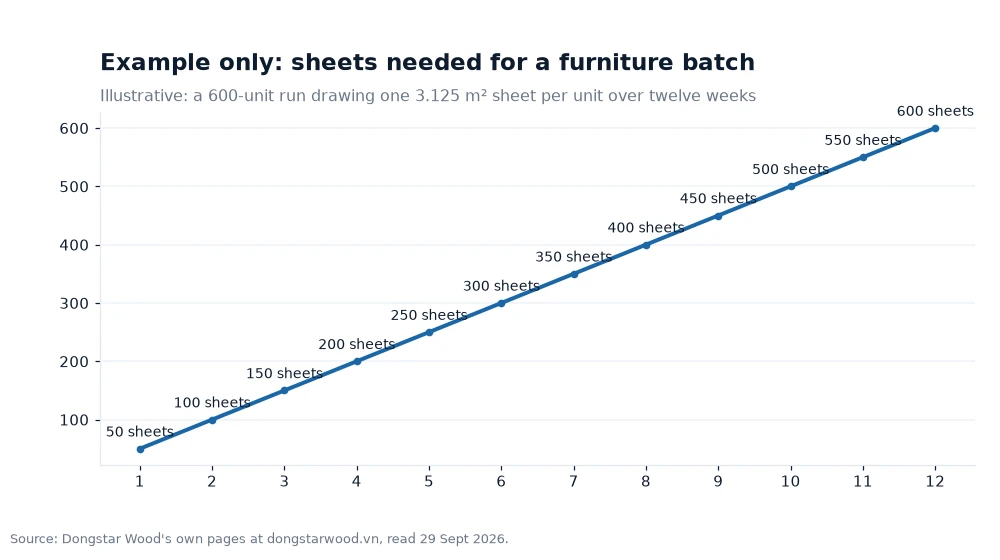
Plan a batch from the span. A furniture run of 600 units drawing one 1250 × 2500 mm sheet per unit needs 600 sheets, and a 1250 × 2500 mm sheet gives 1.25 m × 2.5 m, yielding 3.125 m², so the batch consumes 600 × 3.125 = 1,875 m² of panel. Spread over twelve weeks that is 600 ÷ 12 = 50 sheets a week — a steady draw that lets the mill hold one thickness setting across the whole run.
Frequently asked questions
What thickness should a furniture programme start with?
Start from the component, not the catalogue. Drawer bottoms, backs and partitions take the 6–9 mm band; desks, shelves and hotel fixtures take 12–15 mm; worktops and load-bearing panels take 18 mm. Two settings — 12 mm and 18 mm — keep a whole programme on one cutting list.
Why does the birch range start at 2.7 mm?
The 2.7 mm lower bound extends the line below the commercial 6–9 mm band, covering backing and lining roles that a furniture programme also needs. One product line that spans 2.7 mm to 30 mm lets a buyer source hidden and visible parts from the same supplier.
How does thickness affect machining?
The birch line is engineered for cutting, CNC milling, sanding and edge processing with minimal tear-out across the range, and moisture control with panel tolerance for European climates keeps each thickness flat and on-size. Fix the thickness before the cutting list is written.
Writing the thickness list before the order
The costliest thickness mistake is the one discovered at the machine. Read the company's own profile to validate the operation behind the range, then look at the commercial plywood category to see how the same thickness bands apply across the wider product family. Buyers who write the thickness list first tend to order once.
This article relies on numbers published by the manufacturer's pages at dongstarwood.vn dated 29 September 2026[1].